Every queue got a written procedure, built while the work was being done. The day's record moved into a log that survives a reset. Then the manual work was mapped into a proposal: an estimated up to about 80% of manual processing time in scope for automation, conditional on vendor work.
There were no written procedures. Each queue was learned by watching the supervisor work it, and the documentation that existed did not always match what the supervisor actually did. My own record of the day sat in a working session that could be lost.
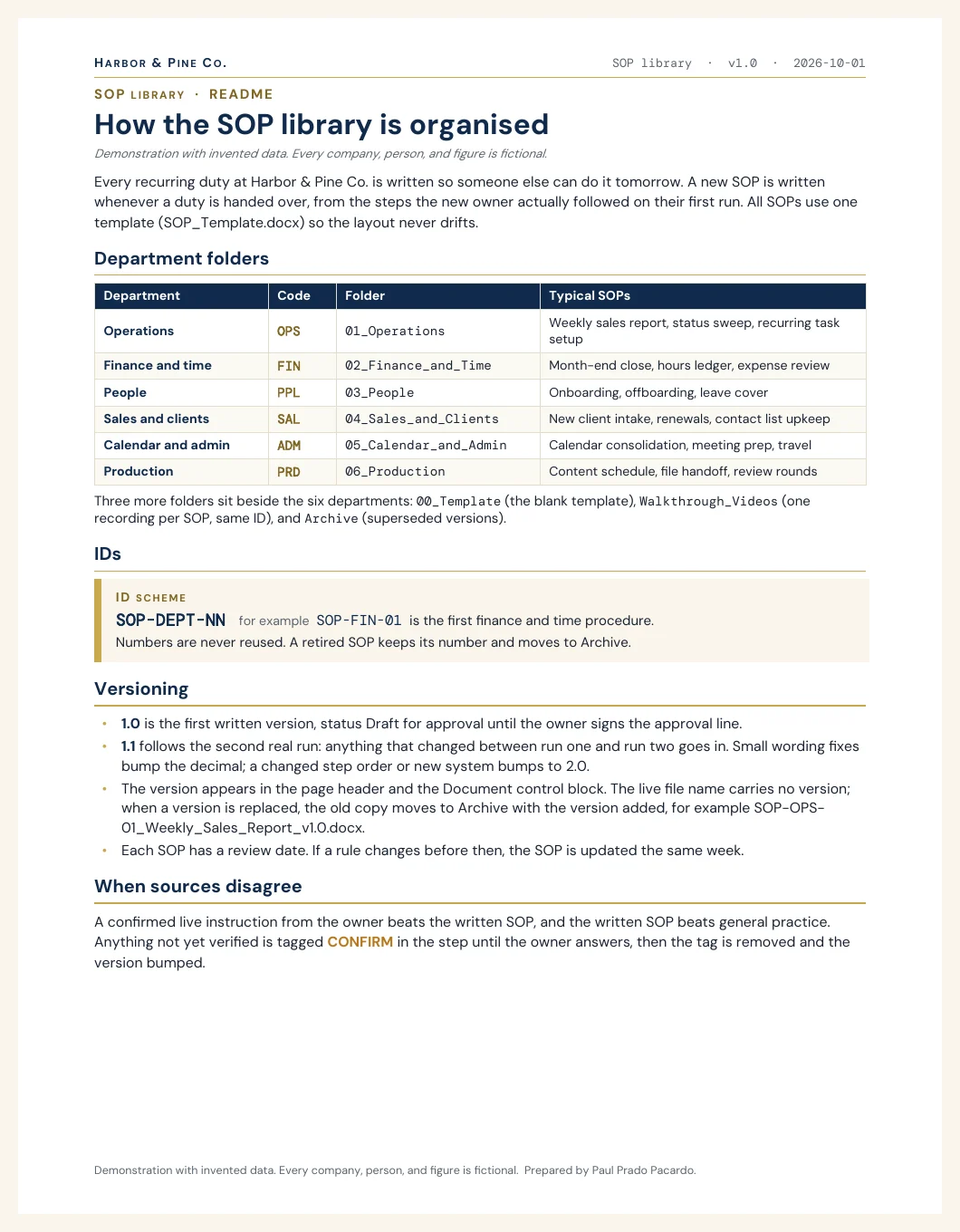
SOPs from live walkthroughs. Every queue got its own SOP, written during or straight after a walkthrough: scope, order of work, a decision table, field rules, templates, what to capture, and known gotchas. Walkthroughs were transcribed so steps could be checked against what was said. The triage SOP has six possible actions and a three-condition delete rule: same person, same date, a complete shift present. Anything else is a contact or an escalation.
A source order, written down. When sources disagree, a confirmed live instruction beats the documentation, and the documentation beats general practice. Anything I had not seen confirmed was tagged CONFIRM in the SOP until the person who owned the rule answered. When a rule was clarified, the SOP changed that day.
A log that survives. Every update goes into a dated log file as it lands: local time, client time, system, and a status in the operator's own words. The file is checkpointed at midday and at the end of the day. Counts are derived from log lines only. If a number cannot be traced to a line, the report says "not recorded".
An append-only handoff. At the end of each day the handoff gets new lines and never loses old ones. It closes with open items grouped by owner and the last copy of every queue, row by row, so the next session starts where this one stopped.
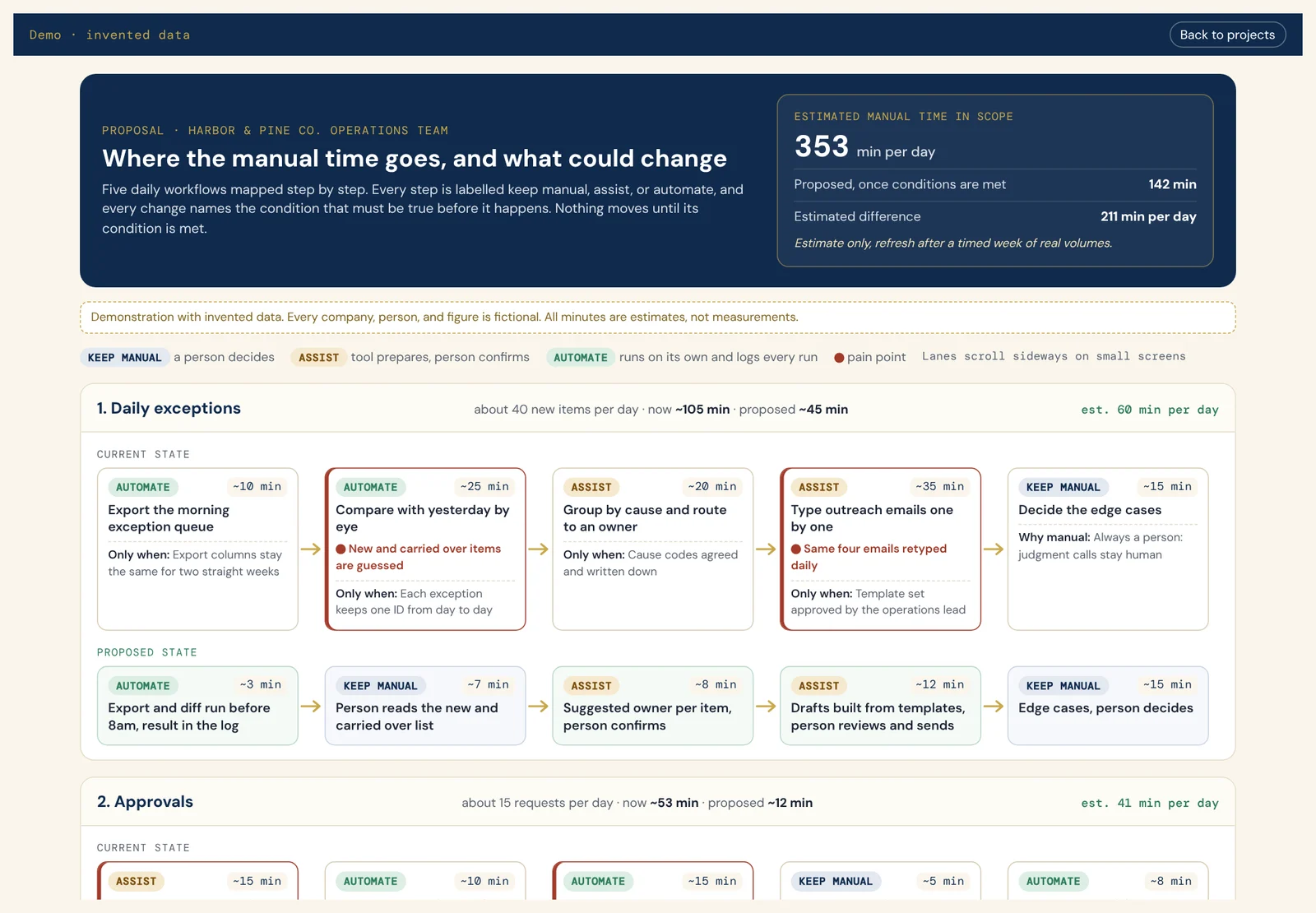
Then the case for automating. With every queue written down, I mapped each workflow as a lane, current state against proposed state, with estimated minutes per step. Every step got one label, keep manual, assist, or automate, and the condition that has to be true before it changes.
Automation flow map (demo): lane 1, daily exceptions
| Current step | Label | Now | Then |
|---|---|---|---|
| Export the morning queue | Automate | ~10 | ~3 |
| Compare with yesterday by eye | Automate | ~25 | ~7 |
| Group by cause, route to owner | Assist | ~20 | ~8 |
| Type outreach emails one by one | Assist | ~35 | ~12 |
| Decide the edge cases | Keep manual | ~15 | ~15 |
| Lane total, est. minutes per day | ~105 | ~45 |
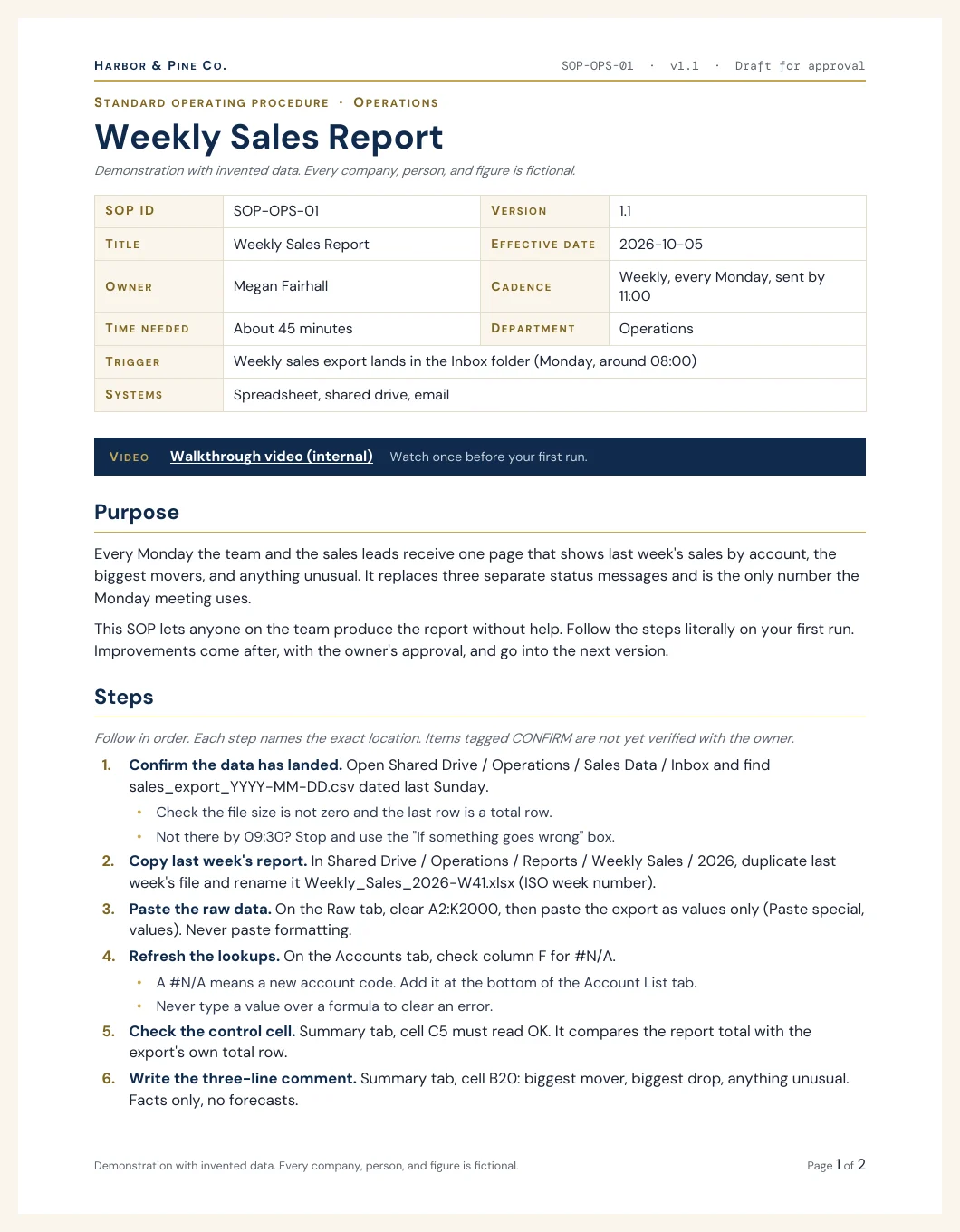
SOP-OPS-01 Weekly Sales Report: document control
| Field | Value |
|---|---|
| SOP ID | SOP-OPS-01 |
| Version | 1.1, draft for approval |
| Owner | Megan Fairhall |
| Cadence | Weekly, every Monday, sent by 11:00 |
| Trigger | Weekly sales export lands in the Inbox folder (Monday, around 08:00) |
| Time needed | About 45 minutes |
The number, honestly. The map put up to about 80% of manual processing time in scope. That is an estimate, conditional on vendor work, to be refreshed after a timed week of real volumes. It is not a result, and the proposal says so.
Click any image to see it full size. Every file here is rebuilt with invented data.
The results, in bands. An SOP for every queue, kept current. No counts lost after the log moved into a file. A banded estimate with its conditions attached.
- A morning's counts were lost when a session reset, and the end-of-day report went out with gaps. The log moved into a file with midday checkpoints.
- Waiting-on-reply totals were first worked out by subtracting fixes from the previous day's number, and they drifted. Waiting lists are now rebuilt name by name from the latest queue.
- A written reimbursement rule and the operator's call differed on one hold. I followed the operator, logged it, and asked the rule owner whether it should become standing, instead of quietly picking one.
Live demo: the automation flow mapDownload SOP-OPS-01 (docx)Download the SOP library (zip)Live demo of the automation flow mapLive demo of the SOP libraryThe Takeover playbook (PDF)The log is the source of truth, not your memoryPart of the work in case study 06
Case study 14